Your hair care routine might carry health risks, this study says
Madison Wornum
Journal Article Link: Siloxane Emissions and Exposures during the Use of Hair Care Products in Buildings
News Article Link: Your hair care routine might carry health risks, this study says
Background:
Peer-Reviewed Article:
The purpose of the study was to investigate, analyze, and characterize human exposure due to inhalation of volatile organic compounds. As well as track both indoor emissions and the movement of siloxanes from indoor to outdoor through ventilation. All of this is in relation to the usage of hair care products. To proceed with their research, they used a controlled residential architectural engineering laboratory that held various ventilators, air conditioners, and fans to promote a room-temperature environment and indoor air mixing. They conducted a total of 46 experiments over 2 months, with 3 different experiment types. These included 35 realistic hair care experiments, 8 hot plate experiments used to evaluate how temperature and heated hair care tools affect VOC emissions, and 3 experiments analyzing how surface area affects VOC emissions. For the hair care experiments, participants brought their own HCPs, testing various types such as creams, serums, sprays, and oils. Participants had varied hair lengths and used a few different types of heated tools, including straighteners and curlers. The researchers used mass spectra to detect which chemicals were emitted.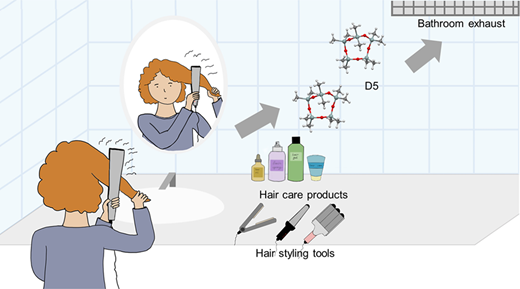

I would say that the most important issue I concluded from this study was the lack of certainty surrounding the health effects of VOCs such as siloxanes. We know that HCPs produce VOCs and that heat and surface tension increase the emission levels. We also know that indoor hair-care routines can contribute to cVMS concentration in urban atmospheres, leading to adverse effects on aquatic environments. But we don't know how these emissions affect our bodies. I would love to know how much this affects our health, especially since hair care is a part of most people's daily routines, meaning we are constantly breathing in these chemicals.
News Article:
Rating: 7/10
The news article discusses the peer-reviewed studies' findings, techniques, and methods. It began by stating what the main idea of the published research was. Then going to discuss the compounds that were focused on: siloxanes. Similar to the peer-reviewed article, they discuss how the specific compounds have not been thoughroughly studies in humans, but that there have been studies on animals showing adverse effects. They then discuss the researchers' methods of experimentation, including who and what ways they analyzed VOC emissions. They tell us that the VOCs were monitored using a mass spectrometer and then go into detail to explain the results the experiments yielded and the conclusions the researchers made from said results. They do a good job of explaining the results in layman's terms so that anyone could understand. Giving basic and clear-cut facts and statistics, such as siloxane emissions accounting for between 71 and 99 percent of VOC emissions. After explaining the results of the experiments, the article then goes on to discuss that the HCPs can have an adverse effect on the atmosphere in urban areas. Concluding that more studies are needed to see the impact of siloxane on human health.
I would say that the article does fall short in some areas. The headline says, "Your hair care routine might carry health risks" (Blakemore, 2023); this makes the health concern sound more scientifically established and backed than it is. They then double down and say that the hair care products "could endanger human health" (Blakemore, 2023), which further exaggerates the known effects of VOCs on humans. Although the peer-reviewed study does discuss potential human health concerns, its main objective is measuring VOC emissions, indoor concentrations, inhalation exposure, and indoor-to-outdoor transport. Its goal was not to directly test whether people developed health problems from using hair products. Although the effects on human health are justifiable concerns, the way they worded it makes readers think that hair care products in general are causing health problems from chemical exposure. Another shortcoming is that they could have done a better job explaining the experimental setup, such as how they had 3 different types of experiments and how each experiment had four periods to replicate real-life application of hair care products. First measuring the background VOC levels; then having the participants do the hair care routine using the styling products and heated tools; and lastly, a 60-minute period to measure how the VOC concentrations decreased. They could have also given a few more measurements that were found. Because of this, I would give the news article a 7 out of 10.


Hello, great blog post! My first concern is that if people are bringing their own products from home, what challenges do you think there are with this? I find it intriguing because it lets people know how their daily routine is affected. However, the concern with this is that so many different products must have been tested that it may be hard to establish a pattern. I think you made a strong point about how the news can sometimes spin things to cause people to get in a frenzy. Having the news article focus so much on the hair care products' impact on human health, when that is not the main focus of the article since there is limited testing, is a little bit shady. You mentioned that the architectural engineering laboratory tries to simulate people's homes and the air they have there. Do you think the results would vary drastically if this experiment was not done in lab? Has there been any research in the past to show if this is similar enough to what people actually use in their everyday life?
ReplyDeleteHi Allison, thank you for your comment! I think participants bringing their own HCPs is both a strength and limitation. It makes the experiment more realistic because they're using products people actually use, but it also introduces a lot of variation between products. The Experiment specifically used 8 different products, 2 types of hair cream, 2 types of hair spray, 2 types of hair lotion, hair serum, and hair oil. So 8 types of products in general. As for the lab, I think results could vary if this was not done in a lab, the lab was built on a mobile home to mimic ventilation, size, and surfaces most likely seen. But if this was not done in a lab than I think results would vary because the ventilation and number of fans is not the same in every space. But their research seems to have provided a realistic representation of what people use in their everyday life.
DeleteThis was a really interesting post! I thought the discussion of hair length and surface area was really interesting. It did make me wonder though whether the location of the hair care product on the hair could affect the health risks associated with HCPs. For example, shampoo is applied directly to the scalp while conditioner is applied to the ends of the hair. Would applying the HCP directly to the scalp, like shampoo, potentially result in greater inhalation or is the exposure the same as applying the product at the ends of the hair?
ReplyDeleteThat is a really interesting question because the location of the product could affect exposure. However, the study did not specifically compare applying HCPs to the scalp vs the ends of the hair so I cannot say for sure from this research that one would result in greater health risks. The researchers did find that greater hair surface area increased VOC emissions, suggesting that how much hair comes into contact with the product may affect emissions.
DeleteThis was a very interesting read. I saw it was mentioned that they tried a large variety of hair care products (sprays, oils, and such) but I was curious if they had readings for specific product categories, as I imagine a hair spray that uses an aerosol propellant would be very different from a curling oil. Additionally, did they list any potential solutions to this issue, such as alternative chemicals that could be used that would eliminate or reduce the release of VOCs into the atmosphere?
ReplyDeleteYes, the researchers did find differences between specific hair-care products. They tested eight different siloxane based products, including cream, serums, lotions, sprays, and hair oil. They found that the amount and type of VOC emissions varied depending on the product. With siloxanes making up 71-99% of total VOC emissions for products. Product C- a hair cream, product D - hair serum, and product E- hair lotion, seemed to have the highest estimated siloxane emissions. They did not list any potential solutions to this issue, but they did mention that in the EU due to the impact on aquatic ecosystems they have established regulations for was off HCP, limiting D4 and D5 to less than 0.1% by weight.
DeleteGreat blog post! I'm very curious about the decomposition pathway of cyclic volatile methyl siloxanes when compared to the simpler straight chained hydrocarbons we covered in class. I would guess that introducing heteroatoms into the carbon chain would result in potentially more dangerous compounds forming, but I'm not sure. The decomposition pathway would also depend on the lifetime of the cVMPs, and introducing heteroatoms would likely affect the stability of the compound.
ReplyDeleteThat is a really interesting question, the study mainly focused on the emissions and exposure to cVMS rather than fully determining their decomposition pathway. However, previous research has shown that once cVMS such as D5 enter the atmosphere, they can react with hydroxyl radicals, producing oxidation products.
DeleteThis comment has been removed by the author.
ReplyDeleteHi madison! this was such an interesting blog post to read. I love learning about hair health so your topic definitely drew me in since I have never thought about the effects of hair products on actual health rather than hair health. I have a ton a questions about it but I will just ask a few haha. I know the article discusses Siloxanes and I was wondering if these are related to the normal Silicones in hair products and if yes, do the silicone free hair products eliminate/reduce the effects of the Siloxanes? Also to follow that up, I know people say silicones are bad for your hair because they cause heavy buildup and coat hair strands preventing hydration and moisture, so I was wondering if that's similar to what Siloxanes do to your respiratory tract, liver and nervous system (and/or did they give any potential health effects at all in paper or news article?) Lastly, do you know if the presence of water (ie putting these products on wet vs dry hair) makes any difference in the VOC emission that these products might cause?
ReplyDeleteHey Sofie thank you for your comment! Yes, siloxanes and silicones are chemically related. Siloxanes are compounds containing repeating silicon-oxygen bonds and silicones are a family of silicon-based materials. The study focused on cyclic volatile methyl siloxanes specifically D4, D5, and D6, which are most commonly used in HCP however I wouldn't say that silicones in HCPs are the same as volatile siloxanes which are smaller in size and more volatile. The study does not test silicone free products so I would be interested in learning whether that would negate the potential health effects , but I don't think silicone-free automatically mans VOC free as their are other volatile organic compounds.
DeleteThis was a great blog post! I've been hearing about health risks associated with hair care products (specifically aerosols like dry shampoo) for a while now, and I've always wondered how true those claims were. I absolutely agree that further studies are needed specifically looking at health impacts of these chemicals. However, I do think this article did a good job of explaining the chemical basis behind these claims. I specifically appreciated the discussion of how heated hair tools increase emissions of VOCs, and how these emissions can also contribute to environmental pollution.
ReplyDeleteYes, I liked that aspect of the article as well. The chemical basis of emissions of VOCs from HCPs was thoroughly explained. I can also appreciate the experimentation of how heat and surface tension relate to VOC emissions.
DeleteThis was a really interesting blog post. Whenever I've heard or thought about hair care products negatively affecting the environment or people themselves I've always thought about the overuse of hairspray during the 60s-80s to give the "big" hair or beehives. I hadn't considered that modern products could cause the same concerns, but it makes sense that chemical aerosols, especially when heated, could negatively affect the human body and respiratory track. I do agree with you that the news article's sensationalization of the impact on human health brings down the rating of the article as that was not the main focus of the scientific paper writ large.
ReplyDeleteHey thank you for the comment! The comparison to 1960 and 80s products was very interesting because from that we know that concerns about hair care products and risk factors to human health are not new. The study did not directly establish that these emissions cause respiratory problems in humans, just that "
DeleteD4 has been shown to cause fatal liver and lung damage in mice. Inhalation exposure to D5, which is the major route of cVMS exposure while applying PCPs, can lead to adverse effects on the respiratory tract, liver, and nervous system of laboratory animals" (Jiang et al.) There has not been much research into the health risks towards humans.
It is so cool to learn more about the chemistries that impact our everyday lives! With how many brands and types of hair care items there are out there, it sometimes is incredibly stressful to know and choose well, even outside of general health concerns. With curlers and straighteners, they have a tendency to be extremely hot very quickly, but a blow dryer might be very different with its different settings. With the release of VOC’s into enclosed spaces after heat application, I would love to know the potency associated with different styling tools. Moreover, with the release of siloxanes into the air, are there any precautionary measures, such as masks, that are effective against VOC’s entering the respiratory tract?
ReplyDeleteWith how large the industry is, I could not imagine what policy enforcement might look like if this area is not a well-studied or funded. If many of these products contain these potentially harmful compounds, even without heat, how much are our bodies absorbing with just simple prolonged contact. If heat is altering the structure of the hair, could that mean more of these siloxanes are permeating into the follicles, and absorbed further?
This is very fascinating and thank you for sharing!
Thank you for your thoughtful comments! The study did compare different styling tools, including straighteners, curlers, and wavers. They found that emissions varied depending on the styling tool, temperature, product, and hair length. The study found that the styling tools, especially straighteners at high temperatures, substantial increased emissions. This is likely because the straightener would have more prolonged and tighter contact with the hair. I'm not sure if a regular mask would keep you from contact with VOC gases, as the study did not test masks as a method of reducing exposure. But they did test using ventilation as a exposure reduction agent. They found that it reduces indoor concentration, but it causes more movement of cVMS from indoor to outdoor.
DeleteHi Madison! I really enjoyed your blog post. I thought it was really interesting how heat increased the amount of VOCs released from hair products, especially since straighteners and curling irons are such a normal part of many people’s routines. I also liked your point about the news article making the health risks sound more certain than the actual study suggests. The study clearly shows that we can inhale these chemicals during hair care, but exposure does not necessarily mean they are causing harmful health effects in humans. It makes me wonder whether simple changes, like doing your hair in a well ventilated room or using lower temperatures on styling tools, could significantly reduce exposure. I’d also be interested to see future studies compare different hair products to figure out which ingredients or product types produce the most emissions. Thank you for sharing!
ReplyDeleteThank you for your comment! To answer your question, yes, doing your hair in a well ventilated room does significantly reduce your exposure to VOCs. But this does cause the risk of VOCs being transported to outdoor atmosphere. The study showed that increasing the temperature of the straightener from room temp to 210 increased cVMS emission factors by 50-310% depending on the compound. So yes, most likely lowering the heat would reduce exposure to emissions.
DeleteHi! I thought it was pretty interesting that the VOCs from air care products can move from indoor spaces into the outdoor environment. I was surprised that something as routine as doing your hair could contribute to outdoor air pollution, wow. Do you think these emissions are significant enough to be considered when looking at overall urban air quality?
ReplyDeleteThe study found that indoor to outdoor transport of VOC emissions could contribute to about 0.4-6 tons of D5 per year. I would personally say that is a substantial amount, however let it be known that is an estimate based on assumptions about product use.
DeleteThis blog post was really interesting and relevant to me! I’ve been using a curling iron every day for the past three years and never knew that my hair-styling routine produced VOCs. I noticed you mentioned that VOC production was proportional to heat, and that using a hair straightener would increase the temperature of the hair to 148.9 and 210 degrees Celsius. These two temperatures seem to be the minimum and maximum temperatures that would normally be found on common hair-styling devices. I was wondering if the study used the full range of temperatures that the device was capable of producing, or if they only tested the minimum and maximum temperatures. If they did test the full range, was the relationship between temperature and VOC production linear, or was there a significant increase in VOC production after reaching a certain temperature threshold?
ReplyDeleteYes, researchers used 3 temperatures, not heat/room temp, 148.9 and 210. So they did not test the entire temperature range. They found that emissions increased with temperature, but because they did not test a full range of temperatures with the styling tools they were not able to produce a linear relationship. However, they did do tests with a hot plate which investigated temperature more broadly which also showed an increase in emissions when temperature increased.
DeleteHey Madison, I really enjoyed reading your blog post and found the topic quite interesting and relevant! As a girl who frequently uses hair products and styling tools, I had not realized the impact that they might have on my own health and the environment. Adding chemicals to hair + adding heat is quite a mix, though, and I hope other alternatives could be found. I wonder what types of products specifically release more emissions, like heat protectants, hair oils, or hair perfumes as well?
ReplyDeleteI also hope more alternatives can be found, and I am hopeful that they will fund more research to see how VOCs from HCPs directly impact human health. The study did not use heat protectants, and I wonder how that would affect emissions, but they found that products C,D, and E had the highest total emission factors, at approximately 1000,1500, and 700 mg/person.
DeleteHi Madison! This was such a fascinating summary. I enjoyed how you highlighted the gap between the study's core objective, measuring indoor air emissions and ventilation pathways, and the media's tendency to frame it as an established human health crisis.
ReplyDeleteYour critique of the Washington Post article was spot on. Headlines often conflate chemical exposure with proven health risk. While D5 has shown adverse effects in animal models, translating those findings to real-world human inhalation at room temperature or under styling heat requires more data.
One aspect of the experimental setup that interested me was how ventilation rates altered the indoor-to-outdoor flux. It makes you wonder if simple we made personal adjustments, like opening a window while using hot styling tools, could significantly mitigate both personal exposure and urban cVMS emissions without needing to completely revamp product formulas right away. This makes me more thoughtful about what I use and how I use
Yes I agree, more data is needed before directly equating these VOC emissions from HCPs to adverse human health risks. To your other point, the study found that increased ventilation lowered indoor D5 concentrations and inhalation exposure, but that ventilation moves more cVMS from indoor environment to the outdoor atmosphere which could potentially be harmful.
DeleteHi, I loved reading this blog post! It is so important to recognize the chemical phenomena that occurs in our day to day lives. I wonder what other products we use that produce VOCs and can potentially cause a health risk. I also wonder if using "organic" hair care products produce less harmful VOCs and siloxanes.
ReplyDeleteHello! I also wonder what other products we use in our everyday routines that produce VOCs and cause health risks. Previous studies did find that environmental impacts from siloxanes due to personal care products were focused on wash off products like shampoos and cleansers.
DeleteHi Madison, great post! I really like how you pointed out the article's shortcomings in making people think risk is tied directly to users rather than it being a study about aerosols and the specific emissions of the products. I definitely think this can contribute to people gaining a false mindset about what the study shows; especially if they don't use the products since they would then be more likely to think this does not apply to them.
ReplyDeleteOn a side note, the direct effect per-person reminds me of a case where a teenage boy used too much spray deodorant (think really, really excessive) over a period of time in a room that was not properly ventilated, and ended up dying from overuse. It was very extreme, though, and definitely not comparable to standard, everyday use. It was from butane gas inhalation in particular, but other aerosols were released when it was sprayed.
Yes I like how you illustrated why the amount (dose) and exposure conditions matter in the conversation of chemical inhalation and reactions to said inhalation. A very high concentration of a propellant in a poorly ventilated space most definitely will have different effects than exposure measured during day-to-day hair-care use.
DeleteHey Madison! Wonderful review. I liked very much reading your analysis of the study and news report. The review of peer-reviewed research on the study and its conclusions regarding the influence of temperature and hair length on VOC emissions from shampoos made the research accessible and intriguing. I agree with your evaluation of the news report and think your criticism of the misleading headline is reasonable, but you also acknowledged valid concerns about the study. I found your discussion of the uncertainty regarding effects on human health very intriguing. I am quite interested in the parallels between indoor air quality and the environment in general. Do you think regulations should focus specifically on limiting D5, or target cVMS as a class of compounds?
ReplyDeleteHi Madison! I thought it was really interesting that the amount of VOC emissions depended not only on the product itself, but also on how the product was used. The finding that longer hair produced higher siloxane emissions especially stood out to me because it shows that exposure can vary between people even if they are using similar products. It makes me wonder whether researchers could eventually develop more personalized estimates of exposure based on factors like hair length, frequency of styling, and how often heated tools are used. I think that could be useful because simply knowing that a product releases VOCs does not necessarily tell us how much exposure an individual person is actually experiencing.
ReplyDeleteHi Madison, this was a very concise and comprehensive review of these articles. I would be interested in knowing how hair texture affects the risk of exposure to VOCs, as people with curly hair are more likely to use certain products than people with straight hair, and hair texture can cause individuals to use different amounts of specific hair products. The uncertainty around the impacts of VOCs on human health is also important to mention. Scientific uncertainty and doubt is often not acknowledged in popular media, and I think that you discussing it here brings to light the biggest problem present in the news article.
ReplyDeleteHi Madison! This is an interesting study, and it seems like there is so much more to be looked into within this topic. This study definitely presents motivation for further studies regarding the impacts of VOCs on human health. I also think it would be interesting to know if there is any variation between product types. I feel like there would be a lot more emissions from hair sprays and dry shampoos than from things like creams and oils. Even creams and oils seem to me that they could have a large variety in concentration of VOCs, depending on their hair care purpose. The study also mentioned that length of hair was proportional to siloxane emission, but explained that this was due to higher surface area. So, I wonder if hair thickness and texture could also play a role in the amount of emissions, keeping the amount of product constant.
ReplyDeleteHowdy Madison. Very thought-provoking post. I was really shocked by how much introducing heat affected the VOC output from hair. Generally, I would love to know more about the contributions from specific types of products, as there are so many genres of hair care. A really thick leave-in conditioner or styling mousse might react very differently from a dry shampoo or even a heat protectant. This reminds me of one time when I was in Sephora, and an employee told me not to buy any aerosol hair products, as the propellant gases were likely carcinogenic. While I'm not sure if that specific property has been unequivocally verified, I looked it up, and the pressurized butane/ propane/isobutane used to blow product outward contribute to VOC concentration in the atmosphere. I also remember an older family member telling me about this hairspray called AquaNet from the 80s, which used CFCs as a propellant. It is interesting to think of all the beauty industry's contributions to anthropogenic pollution, the evolution of which tracks very closely with the field of environmental chemistry.
ReplyDeleteHi Madison! I thought it was really interesting how much heat increased VOC emissions, especially since heated styling tools are something people may use several times a week for years. It made me wonder whether repeated exposure is more important than the amount someone inhales during a single hair-care routine. Even if one use produces relatively low exposure, could frequent use cause greater concern over time, or are these compounds eliminated quickly enough that exposure does not accumulate? I think looking at long-term exposure patterns would also help clarify the gap you mentioned between knowing these products release VOCs and actually knowing what that means for human health.
ReplyDeleteThis was a super interesting article and I was definitely intrigued by the headline for the same reasons that you mention in your rating section, and ultimately, I'm left with so many questions... For instance, there isn't really a control group established for the experiment, and the nature of the experiment itself makes it so difficult to establish an actual concrete pattern. This makes me question how valid their data really is and if they presented it purely as trends or as actual conclusive data? Additionally, I wonder since long hair and heat had impacts on D4, D5, and D6 emissions, what could patterns regarding different hair types look like? For example, people with curly hair frequently have to use more products and the routine takes longer, but many don't use heat since it's bad for their hair. Instead, they may use a diffuser and/or cool air from a hairdryer. This makes me wonder further what the emissions would look like for this instance of using a hairdryer but on a cool setting... Finally, I also can't help but wonder about their conclusions regarding D5 emissions from VOCs in the environment... How did they gather this data? Is it drawn from additional experimentation or is this an estimate somehow acquired from this data? It doesn't seem as though you could gather these conclusions from this type of experiment.
ReplyDeleteI thought it was interesting how much hair length and heat can affect the amount of siloxanes released into the air. I especially found it surprising that longer hair could produce several times more emissions because of the increased surface area. I also agree that the news article made the health risks sound more certain than the actual study showed. Since the researchers mainly measured emissions and exposure rather than directly studying health effects in humans, I think more research is needed before we can know what these chemicals actually do to our health. It definitely makes me wonder how much exposure people get over time since using hair care products is such a normal part of everyday life. Something I was overall wondering was how much exposure to these chemicals do we actually experience over time, and what could the long-term health effects be from using hair care products regularly? I know this was partially address but the articles kept having me with this question on my mind!
ReplyDelete